
Architecture
The SDK is a renderer-side conversation UI with optional trusted adapters beside it. Each layer has a specific trust boundary and public vocabulary.
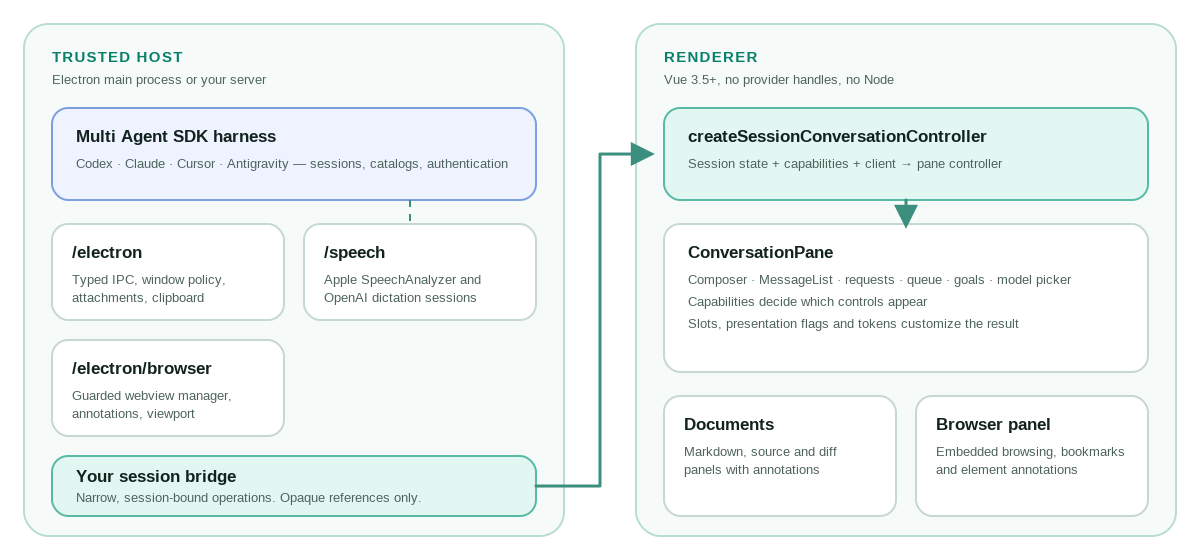
Where the SDK sits
Three packages cooperate. Only the first is this one.
| Package | Owns | Must not own |
|---|---|---|
@korus-dev/agent-ui-sdk | Vue conversation controls, session and controller composition, host capability contracts, optional Electron, speech and browser adapters | Provider execution, protocol handling, authentication, navigation, persistence |
@korus-dev/multi-agent-sdk | Harness sessions for Codex, Claude, Cursor and Antigravity: neutral state, capabilities, requests and prompts | UI |
@korus-dev/codex-sdk | The raw Codex protocol | Neutral session semantics, UI |
Release order follows the dependency order: codex-sdk, then multi-agent-sdk, then agent-ui-sdk.
One package, several entry points
The package has explicit, extensionless exports so that trusted code never ships to a renderer by accident.
| Entry | Layer | Trust |
|---|---|---|
| root | Vue controls, session composition, themes, providers, document panels | Renderer |
/styles.css | Control styles and packaged fonts | Renderer |
/host | Capability contracts and prompt-option translation | Neutral |
/browser, /browser-ui, /documents | Browser contracts, browser panel, file classification | Renderer |
/electron, /electron/preload | Typed IPC, window policy, native capabilities | Main process and preload |
/electron/browser, /speech | Guarded browser manager, speech sessions | Trusted process |
A boundary test walks the emitted runtime import graph of the root entry and fails if it reaches Node, Electron, ws or provider execution modules.
Data flow
- The trusted host runs a harness session and receives neutral
SessionStatesnapshots plusHarnessCapabilities. - Your bridge carries the snapshot to the renderer and carries session-bound actions back. Identity stays in the host; the renderer holds opaque handles at most.
createSessionConversationControllerprojects the snapshot intoConversationPaneStateand maps pane actions onto your client operations.ConversationPanerenders from that state. Capabilities decide which controls exist; presentation flags decide which optional ones are shown.
Harness session ──snapshot──▶ your bridge ──▶ SessionState
                                                  │
        client operations ◀── controller ◀── createSessionConversationController
                                                  │
ConversationPaneSnapshots are authoritative. Keep message identities stable across updates so settled Markdown, selection and scroll position survive streaming.
Capability-driven behavior
The UI never asks which provider it is talking to. It asks what the session can do:
Capabilitiesflags (steering, interruption, goals, plan mode, history, turn editing, approvals, models, skills, reasoning effort, service tier) enable controls.capabilities.permissionslists the harness's own permission ids; the app supplies wording.- Catalogs for models, commands, skills, plugins, files and mention groups arrive as host-owned state.
- Policy flags (
attachEnabled,canForkTurn,canEditTurn, …) reflect host decisions.
Do not invent a universal model list, and do not map one harness's permission ids onto another's.
The renderer boundary
No raw provider payloads, Node primitives, filesystem paths, credentials or Electron objects need to cross into renderer code. Attachments are HostAttachment records whose reference is an opaque host capability, never a path. See the security boundary.
Optional adapters
- Electron (
/electron):registerNativeIpcinstalls validated handlers for attachments, clipboard, links, image previews and speech;installWindowPolicykeeps windows on the app renderer; typed IPC helpers carry your own session bridge. - Speech (
/speech): Apple SpeechAnalyzer through a packaged universal helper, and OpenAI realtime dictation. Both consume mono Float32 PCM. - Browser (
/electron/browser,/browser-ui): a main-process manager owns navigation, annotation and viewport policy for renderer-hosted webviews; the Vue panel is the UI.
Where code belongs
| Concern | Lives in |
|---|---|
| Rendering messages, composer, requests, tools | This SDK |
| Running sessions, model catalogs, authentication | @korus-dev/multi-agent-sdk |
| Navigation, titles, conversation lists | Your application |
| Durable attachments, retention, drafts | Your application |
| Authorization and policy | Your trusted process |
| Diff views and treemaps | Your application, over the document panels |